Table of Contents
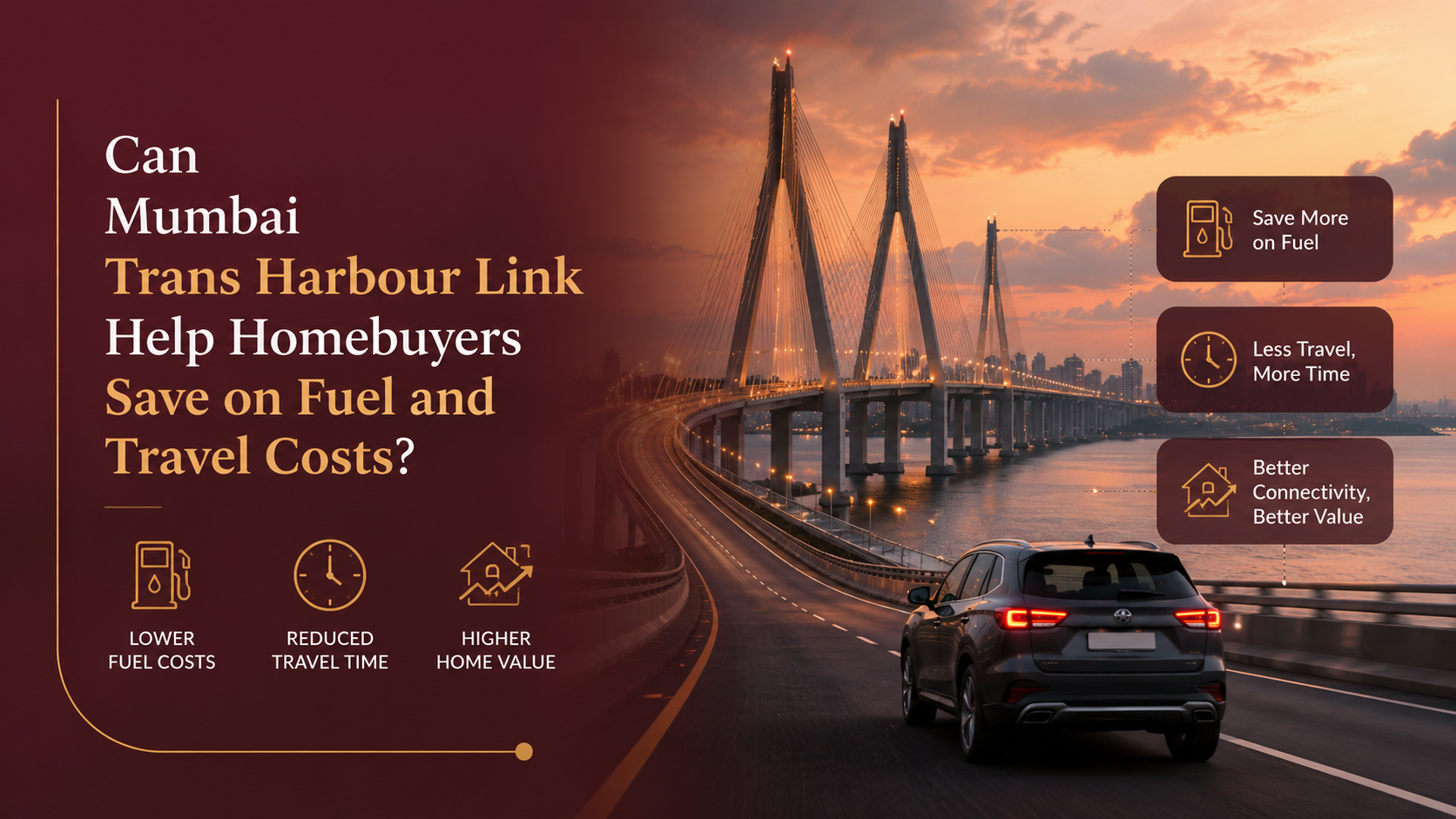
Can Mumbai Trans Harbour Link Help Homebuyers Save on Fuel and Travel Costs?
The 22-kilometre Mumbai Trans Harbour Link has been a life-changing commuting experience for Mumbaikars, as it can save them travel time, especially during busy hours, by connecting Thane Creek directly. Situated 16.5 km above the water, it is one of India’s longest sea bridges today. During heavy traffic, motorists traveling from south Mumbai toward the New Airport Influence Notified Area (NAINA) and the Mumbai–Pune corridor could save roughly 30–45 minutes compared with routes via the Eastern Freeway and the Sion–Panvel Highway.
Not only commuting, but this project was also envisioned to support development in Navi Mumbai and the surrounding regions. It also reduced congestion on existing roads, and there is plenty of space for the movement of vehicles transferring labor and materials. Let us see in this blog how this trans harbour link can help homebuyers save on fuel and travel costs.
Commuting time: a real cost to consider
A person traveling from Navi Mumbai to South Mumbai or vice versa will end up spending not only thousands of rupees on fuel and vehicle maintenance, but also spend hours of time in traffic jams. Over several years, these expenses can add up to many lakhs of rupees.
Studies suggest that urban Indians spend between 7 and 10 hours every week commuting, which adds up to more than 500 hours annually, equivalent to nearly 21 full days every year spent traveling. This overburdens people and eventually adds to physical and mental stress, which will eventually lead them to spend thousands on treatments. Nobody wants this. Mumbai, being a busy metropolitan, people will be doubly impacted by stress because of heavy commuting hours.
Why connectivity is crucial for home buyers
Whenever someone looks for a new home, whether to buy or to rent, first they think about how far the home is from school, if they have children, or how far it is from my office. So, connectivity is the highest driving factor of decisions made by homebuyers, anywhere in the world. They prefer locations close to their preferred areas just for easy and effortless daily commuting and a reduction in travel and fuel costs. Evidently, areas with the highest connectivity facilities have seen an average of 12% rise in property prices. At the end of the day, people choose comfort over hiccups, that too, daily.
Infrastructure developments like the Mumbai Trans Harbour Link shape the urban development for a long period. Because of the connectivity projects, property values increase gradually, which encourages buyers to buy properties before the projects are stabilized and then reap the profits once they are up and running.
Even for rental, properties with the highest connectivity are in high demand as students, families, or professionals prefer well-connected homes. It gives them a sense of comfort and reduces anxiety over time. Commuting facilities also provide them with the opportunity to move into more sophisticated residential spaces that offer higher standards of living with access to social and office hubs.
Before the trans harbour link came into being, the commuting time between South Mumbai and Navi Mumbai used to take 90 minutes, but now, it hardly takes 25 minutes. This convenience has improved the work-life balance of people so far, and the real residential demand is growing too among investors and end-users.
Reduction in travel and fuel costs
Maharashtra government officials have estimated that commuters can save up to Rs 500 worth of fuel as a result of this trans harbour link. It is because of the reduced distance, not much traffic, and smoother driving conditions.
Suppose someone drives between South Mumbai and Navi Mumbai every working day:
Fuel saving: approximately ₹500 per round trip
If there are 22 working days per month, then they end up saving ₹11,000/month
This means, annually, they can save up to ₹1.3 lakh/year
Studies associated with the project estimate:
- Up to 70,000 vehicles per day use the bridge.
- Significant reductions in congestion on older routes such as the Sion–Panvel Highway.
- Freight transport times between Mumbai and Raigad are expected to fall by about 40%, generating large logistics cost savings.
But there is a catch. The commuters are also supposed to pay a toll, which is around ₹200 one-way for cars. So how much each one saves depends entirely on the route, vehicle mileage, and other parameters. But for people traveling between South Mumbai, Navi Mumbai, Pune, or JNPT, the amount of time they save is invaluable and is as important as fuel savings.
Impact of the Trans Harbour Link on Navi Mumbai areas
The property demand has grown after the advent of the trans harbour link in Navi Mumbai, including areas like Ulwe, Dronagiri, Panvel, Pushpak Nagar, and the nodes around the Navi Mumbai International Airport. These locations offer a combination of affordability and future appreciation.
One of the best and most active developers in Pushpak Nagar in Kharghar currently is Shreeji Ventures. We give our customers a different kind of experience. One of our most talked-about developments is Shreeji Divine, a large luxury housing project spread across 6.25 acres. The project includes four 48-storey towers with different apartment options, including 2 BHK, 3 BHK, 4.5 BHK, and 6.5 BHK homes.
Another important aspect of our buildings is multi-storey car parking areas, including a clubhouse, swimming pool, jacuzzi, gym, yoga space, party halls, gardens, fountains, and children’s activity areas.
We have built 4 million sq. ft so far, and one important factor why our customers trust us is that our projects are all MahaRERA registered (P52000034060). We have built several projects in Kharghar, Nerul, and Roadpali.