Table of Contents
Carpet Area vs Built-Up Area: Why Indian Homebuyers Are Becoming More Cost-Conscious in 2026
Imagine you are looking to buy flats in Navi Mumbai and have decided to go for a 1500 square ft one. You may think you bought the whole area and will get to use it for various purposes, but you end up surprised to find the rooms smaller and the spaces more congested than you pictured. It is not because the builder lied or your broker lied. It is that you failed to research before looking for flats. The flat can be 1500 square ft, but you may not get to use the whole of it.
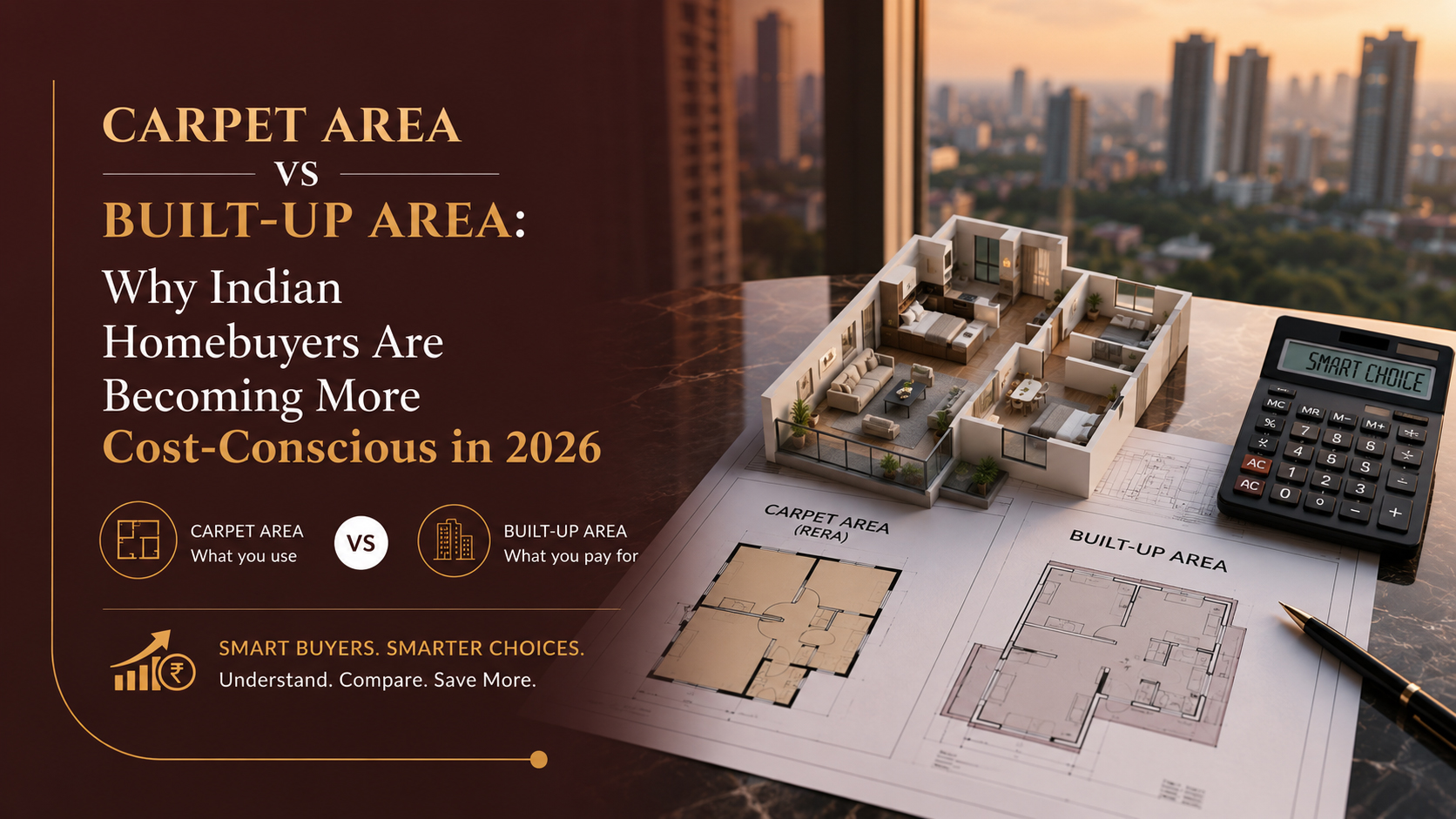
The gap between what you pay for and what you get to use has a name. They come down to: built-up area and carpet area. If you are confused between these terms, don’t worry; this blog will clear all your doubts, as the Real Estate (Regulation and Development) Act 2016 has been accepted.
Carpet area
The space that you actually use, as a kitchen, living room, bedroom, etc falls under the carpet area. It literally means that the space where you can actually roll out your carpet.
The RERA definition goes like this: It is the net usable area in the total built-up area. It is usually about 80-85% of the built-up area or 60-75% of the super built-up area (it is equal to the built-up area plus your share of common areas like lift, staircase, gym, club, etc), but it depends on the loading factor. A loading factor is nothing but the percentage your developer adds on top of the carpet area to arrive at the super-built-up area.
It usually includes even the thickness of the internal walls inside the flat, but excludes outer or external walls, balcony, open terrace, etc.
The formula to calculate the carpet area: Sum of (length * width) of every usable room. Have an idea that about 70% of the total area, on average, covers this area.
Built-up area
It is nothing but the addition of the carpet area and the structural footprint of the flat. It includes everything within the four walls of your unit. It includes the carpet area, internal walls, external walls, balcony, any passageway within the unit, and utility (if there is), etc. If the carpet area is the space where you live, the built-up area is the constructed space.
It comprises 20% extra compared to the carpet area, as it includes your home balcony, utility, etc. The formula to calculate the carpet area: carpet area + wall thickness + balcony area.
Why Indian Homebuyers Are Becoming More Cost-Conscious in 2026
Let us see some reasons why homebuyers are becoming cost-conscious:
- While the property prices increase by 5% each year, people's salaries increase by 8%. In this case, buying a property must sound less compared to household incomes, but even as incomes are higher, buyers still feel stretched to buy a flat as property prices are very high, currently. This will make buyers think about the value they receive for the money they invest. For example, for buyers, a house A with a lower price but a larger size on paper may not entice much compared to a house B that can offer more usable living space.
- RERA has made it compulsory that every flat rate is calculated only based on carpet area rather than super built-up area, etc. This rule has brought buyers to be conscious and ask questions about actual usable space, and to correctly assess the advertised space before buying. This brings transparency and value to the money that is being paid. Buyers now cannot be misled.
- In 2026, flats are being bought by end-users compared to investors. Therefore, people are looking at usable space, ready-to-move-in, etc before buying a property, making carpet area a crucial factor to buy.
- There are too many options available for buyers now, everywhere within a metropolitan city, with an increased number of builders and apartment buildings. Some apartments they feel can provide a better appreciation rate, even though they are expensive, while some are cheaper but are larger in size, etc. Buyers are becoming more cautious before investing in the right property.
Why You Must Choose Shreeji Ventures in 2026
One of the biggest challenges for homebuyers is understanding how much space they are actually receiving for the amount invested. Many projects are marketed for their super-built-up area, but the buyers look for the true measure of value via carpet area.
At Shreeji Ventures, a typical 2 BHK offers a saleable area of 1,555 sq. ft., including access to common infrastructure and amenities within the development. More importantly, the home delivers a RERA carpet area of 876 sq. ft. along with a 79 sq. ft. balcony, resulting in 955 sq. ft. of private usable space for everyday living.
This distinction is important because carpet area directly reflects the space homeowners can furnish, occupy, and enjoy. By providing clear disclosures across the saleable area, carpet area, and balcony area, Shreeji Ventures enables buyers to make informed comparisons and understand exactly what they are purchasing.
By offering a well-balanced combination of usable living space, transparent area disclosures, and practical layouts, Shreeji Ventures presents a compelling value proposition for homebuyers seeking long-term comfort and investment potential in 2026.