Table of Contents
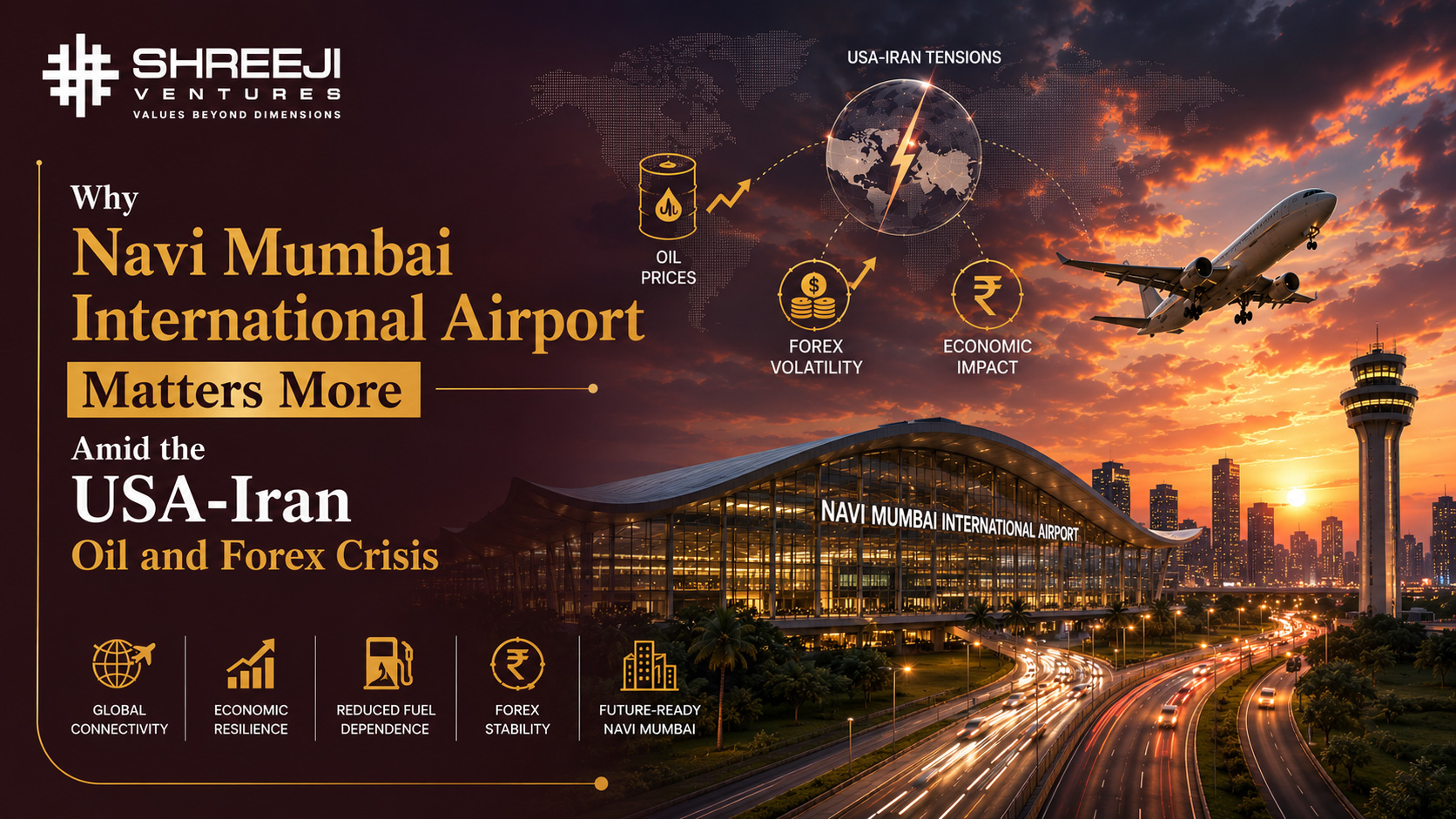
Why Navi Mumbai International Airport Matters More Amid the USA-Iran Oil and Forex Crisis
Currently, the Indian economy is recovering from the repercussions of the war between the USA and Iran, which triggered the major oil crisis not only in India but also globally. As a result of the closure of the Strait of Hormuz for months, the global crude oil prices jumped above 120$ per barrel, and for India, which imports at least 80% of its oil reserves from the Middle East, this came as a massive disruption. It also led to a major currency crisis, expensive imports, and depleting foreign reserves.
During the crisis, the major infrastructural milestone in the country has taken on a new meaning. Navi Mumbai International Airport (NMI), which began operations in December 2025, is projected to be a major asset to India’s and Mumbai’s, the financial capital of India, economic survival.
Of course, the airport was established to solve the overcrowding problem at Mumbai’s main airport, but it is all set to prove itself to me more than just for this. Let us see in this blog how this aviation milestone matters more than ever in 2026, amid the financial crisis.
-
Cutting down on aviation fuel costs
The global tensions have caused oil prices to spike, which, of course, has caused aviation turbine fuel (ATF) prices to skyrocket. And the aviation fuel is not very cheap, and it constitutes the biggest part of aviation expenses. Operating flights becomes costly because of this, and evidently, many scheduled flights were cancelled across the world.
Coming back to NMI, earlier, most flights had to loiter in the sky for more than 30 minutes just to wait for the landing slot as the air traffic was heavy in the main Mumbai airport. This itself consumed most of the aviation fuel.
But currently, operating up to 78 daily departures under its current Summer 2026 schedule and connecting to 46 domestic destinations, NMI has taken off the burden from the main airport. All the airlines can now land without any delay or wasting fuel in the skies. This efficiency helps airlines cut losses and keeps domestic ticket prices stable for travelers.
-
A barrier to protect the weakening rupee
The Indian rupee has been falling because of the ongoing tensions. Besides, India needs to buy oil from foreign countries too, in exchange for dollars. Higher oil prices mean India must spend a lot more of its dollar reserves just to keep buying the oil. To do this, India needs to continue trading (exports and imports) more and more and earn as many US dollars as possible.
This is where NMI comes into play. It comprises a massive cargo capacity in phase 1, which is built to handle 0.8 million tonnes of cargo per year. Besides, the airport is located next to most industrial corridors like Dronagiri, Taloja, Jawaharlal Nehru Port Authority (JNPA), etc. This allows easy export of commercial goods, electronics, and textiles via air freight. The airport indirectly boosts exports and, in turn, brings more dollars into India.
-
Helping local supply chains
There are some shipping issues, especially because of the geopolitical crisis in West Asia. The crisis has brought uncertainty to ship movements, also leading to expensive marine insurance rates. This has disrupted the movement of goods that rely on ship transfer.
NMI forms a major connection for domestic trade from tier 1 and tier 2 commercial hubs not only in Mumbai but the whole India. The airport supports the movement of important goods, medical supplies, etc without any disruption.
-
Holding the real estate sector together
The higher oil prices have resulted in RBI to keep interest rates high. This has affected even the home buyers. Despite this challenge, the areas around the airport like Panvel, Kharghar, Ulwe, etc have found massive real estate advantages as the property prices are gradually appreciating in value. Whoever invests in these areas in 2026 is going to be happy in the next 3 to 5 years.
The airport generates numerous jobs in sectors like logistics, aviation, travel, and hospitality, etc, giving a steady income source for many families. Even with the global crisis, NMI has kept many people busy with work and livelihood, along with returns for their investments in the long term.
Conclusion
Although everybody thinks of an airport as a hub for transferring passengers, it holds a whole different place in the economy, and NMI is no less. With its focus merely on domestic operations currently, the airport is catering to fuel cost cuts, boosting logistics, etc. The economic crisis may die down eventually, but the airport continues to support the way it is now, and perhaps even more in the future.
If you are looking to benefit from the long-term development potential surrounding the Navi Mumbai International Airport, explore the thoughtfully planned residential projects by Shreeji Ventures. We have built 4 million sq. ft so far, and one important factor why our customers seek us is that our projects are all MahaRERA registered (P52000034060). We have built several projects in Kharghar, Nerul, and Roadpali, too.